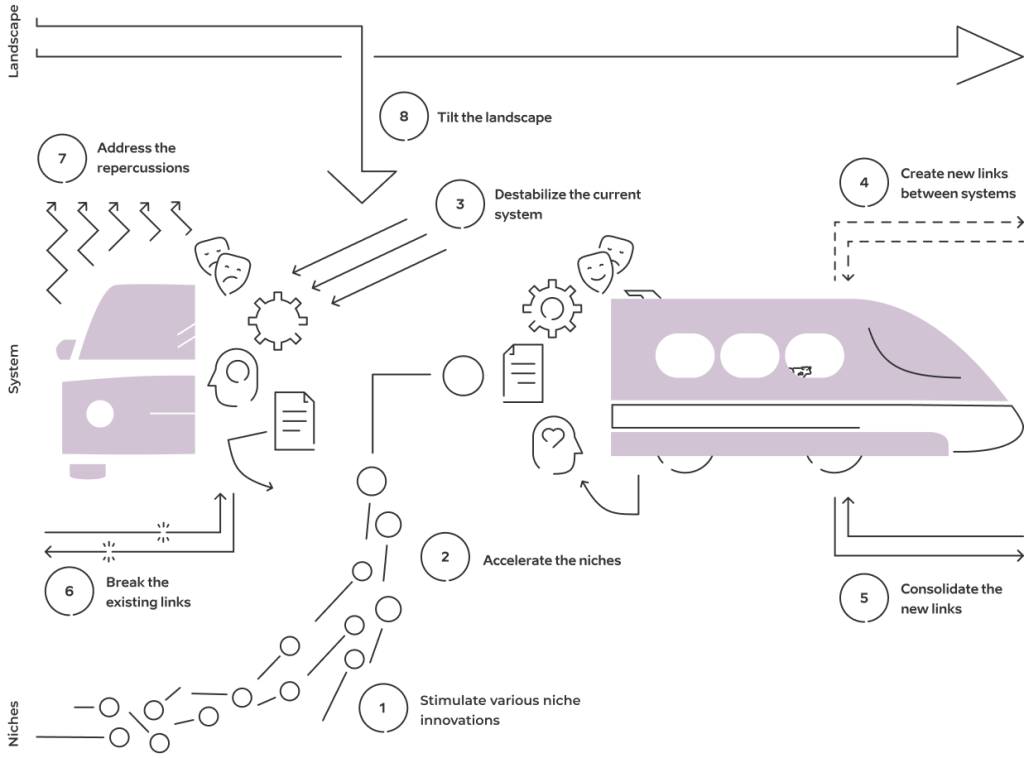
We developed a framework of six intervention points for accelerating transitions in single systems. This was later expanded to eight to pay more attention to interacting systems.
1
Stimulate different niches
Provision of support for new ways to get things done, including technologies, business models, regulations, everyday practices, and cultural meanings. These interventions (for example, research grants) aim to ensure there is a diversity of solutions for any sustainability-related challenge.
2
Accelerate the niches
Emerging niches are often not strong enough to survive the harsh conditions of the market economy. Interventions in this category focus on upscaling single niches or connecting different ones, e.g. a platform where electric and self-driving vehicle developers can experiment with mobility-as-a-service solutions.
3
Destabilize the current system
Supporting novelty is often insufficient on its own. What is also required is decreasing support for currently dominant practices. For example, the United Kingdom is committed to phasing out the sale of new petrol and diesel cars from 2030.
4
Create new links
Interventions in this category focus on the creation of new types of links between systems, e.g. using the renewable energy system to electrify railways.
5
Consolidate links
This is about interventions that strengthen emerging connections between systems. For example, support for vehicle-to-grid systems can create a feedback loop between energy and mobility systems.
6
Break links
This involves various means for disrupting unsustainable links between systems, e.g. the global divestment movement aiming to cut funding for fossil fuels and petrochemicals.
7
Address broader repercussions
Single- and multi-system transitions create an array of unintended, often negative consequences. Interventions in this category aim to address them in various ways, e.g. by providing retraining for people losing fossil fuel related jobs in mining regions.
8
Tilt the landscape
This entails interventions in the broader environment of socio-technical systems, e.g. through international treaties such as the Montreal Protocol or the Paris Agreement.
Intervention points and transitions
Overall, interventions for supporting transitions should be:
System-wide, i.e. including technological, economic, regulatory, social and cultural innovations;
Multi-level, i.e. including niches, single systems, multiple systems and the landscape.