
What is what in Deep Transitions?
The Deep Transitions framework connects processes on three levels: transitions in single systems, successive great surges of development and the formation of industrial modernity. Here, we will explain all core concepts.
What are socio-technical systems?
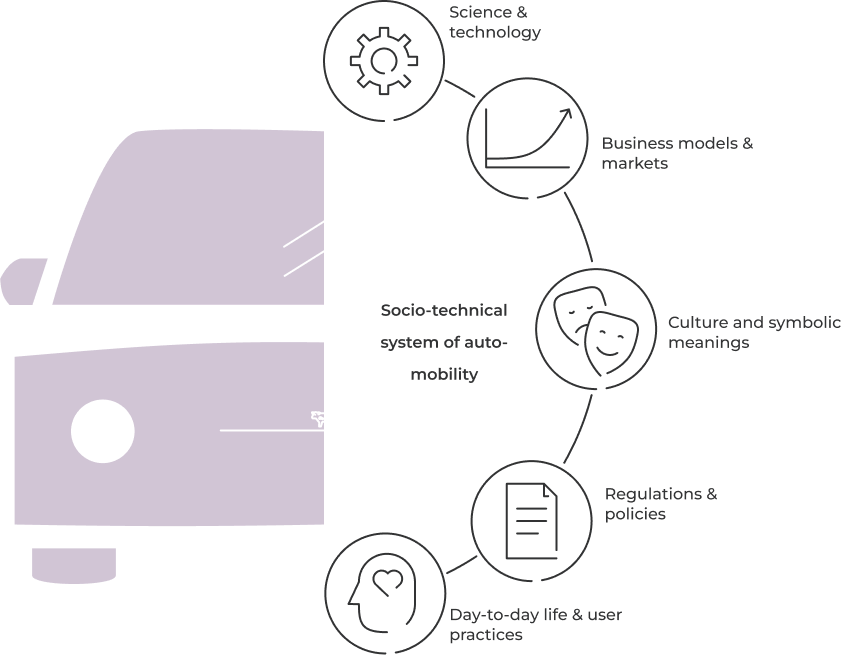
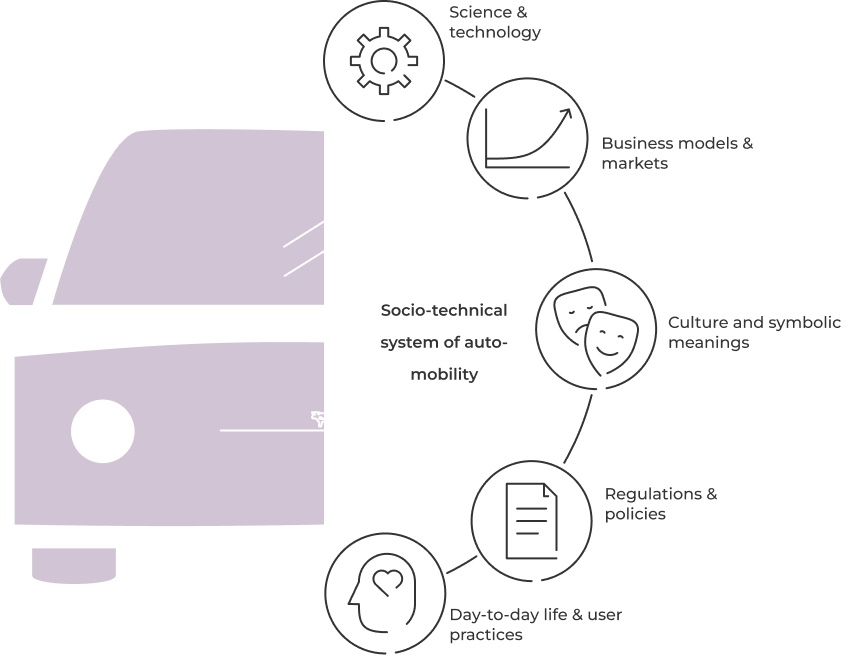
We view society as a network of socio-technical systems that fulfil human needs such as energy, food, housing, waste management and communication. Each system includes elements from different societal domains including science and technology, business and industry, policy and governance, users and everyday life, and culture.
For example, the mobility system includes cars, gas stations, paved roads, leasing, traffic regulations, the practice of commuting, and the symbolic meaning of private car use as embodying personal freedom. The interconnectedness of such elements makes socio-technical systems highly resistant to major changes.
The components of a STS
What are socio-technical transitions?
Change in socio-technical systems is usually incremental and proceeds in fairly predictable directions. For example, the processing-speed of computers has become quicker in the communication system and cars have become gradually safer in the mobility system over time. However, on rare occasions systems experience more radical changes in their basic mode of operation. This shift, affecting all system dimensions, is called a transition.
Transitions are driven by interactions across three levels:
- System: This level represents the currently dominant and established way of doing things (e.g. individually owned and privately operated gasoline cars in the mobility system);
- Niches: alternatives to the system, including both technological (e.g. electrical vehicles, self-driving cars) and social innovations (e.g. ridesharing);
- Landscape: pressures from the external environment that can open up an opportunity for change (e.g. climate change, economic crises).
A transition occurs when 1) landscape trends or shocks put pressure on the currently dominant system; 2) the system is unable to find an internal solution to these problems; 3) this opens up a window of opportunity for alternative niches to gain a foothold and eventually replace the system. For example, the landscape trend of urbanization in the 19th century created problems for the dominant mode of mobility based on horse-drawn carriages. This stimulated the emergence of niches like bicycles, trams, and cars with the latter ultimately emerging as the winner.
A socio-technical transition
Read more
What are great surges of development?
Starting from the late 18th century, industrial societies have experienced five 40-60 year and increasingly global great surges of development. Each surge is powered by new technologies and principles of using them, e.g. electrification from the 1870s, mass production from the 1910s, or digitalization from the 1970s. These principles are first introduced in various niches, then break through in particular systems and ultimately come to coordinate the development of many different ones.
For example, the key ideas of mass production such as interchangeability of parts or moving work to worker were deployed in weapons production and slaughterhouses already in the 19th century. However, it was only when Henry Ford managed to connect the dots for car manufacturing in the early 20th century, that mass production became a standard spreading to many socio-technical systems. Today, the logic of mass production still underpins the provision of consumer goods, housing and many services, while mass consumption constitutes a pervasive feature of societal living in affluent countries.
Surges of development and Deep Transitions

Read more
What is industrial modernity?
The development of each surge left behind fundamental beliefs, rules, and behaviours that became characteristic of every industrial society and are still present today. For instance, while in 1874 it was considered innovative for Friedrich Bayer to hire an educated chemist to work in his dyestuff factory, science-based technology development is now a standard across all systems.
What are Deep Transitions?
Starting from the late 18th century, industrial societies have experienced five 40-60 year and increasingly global great surges of development. Each surge is powered by new technologies and principles of using them, e.g. electrification from the 1870s, mass production from the 1910s, or digitalization from the 1970s. These principles are first introduced in various niches, then break through in particular systems and ultimately come to coordinate the development of many different ones.
For example, the key ideas of mass production such as interchangeability of parts or moving work to worker were deployed in weapons production and slaughterhouses already in the 19th century. However, it was only when Henry Ford managed to connect the dots for car manufacturing in the early 20th century, that mass production became a standard spreading to many socio-technical systems. Today, the logic of mass production still underpins the provision of consumer goods, housing and many services, while mass consumption constitutes a pervasive feature of societal living in affluent countries.
Deep Transitions
